Season 4 Episode 12: Season Wrap up And Christmas Special

Join Brandi and James as they review the highlights of the podcasts from last year. With 12 episodes, they had many wonderful guests covering a broad range of topics impacting cross-cultural workers. This episode ends with three guest spots sharing stories of their holiday memories living cross-culturally. Meet our Guests below or in the podcast!

Eve Austin lived for 20 years living in Tajikistan and Turkey with my family from 1996-2016. During that time, she was a mom, missionary, educator, and entrepreneur. She transitioned into counseling in 2013 and worked abroad with culturally diverse populations, including refugees and survivors of human trafficking. Her life and work overseas provides her with understanding and empathy to journey with clients from diverse backgrounds through the challenges of transition, relocation, and cultural adjustment. https://eveaustin.com

Lisette Gabre is an extroverted Swede who moved to Asia almost thirty years ago with her husband and at that three very little children. She raised her three TCKs in Asia from baby to 18. The kids are now grown and she is a grandmother of six. Lisette has been involved in member care since she prepared to move to the field. Presently her pillow and husband are in Chiang Mai Thailand, but she serves the world as the TCK and Family Care Specialist for OM International.

Anna Danforth is an author, TCK advocate, and traveling speaker/trainer with TCK Training. Growing up in Cameroon as a third culture kid, she developed a deep passion for helping global families thrive in cross-cultural environments. Anna holds a degree in Secondary French Education and an MAEd in Instruction and Curriculum. Married to her high school sweetheart from DR Congo, Anna and her husband raised their two children in Lesotho and South Africa, where they continue to work in education and job skills training.

Season 4 Episode 11: Sabbatical with Jeff Simons

Join Brandi and James as they interview Jeff Simons on Sabbaticals. Jeff is a missiologist at core. He works out this passion as a trained leadership coach, and a cross-cultural companion to global leaders in major transition to, within, and from the field. His unique wiring plays out as a Resourcing Developer—of people, tools for global workers, and literature; Imaginative Innovator—of forward-thinking missiological structures and ministry strategy; and as a Restorative Artist—by empowering the journeys of workers forward through redemptive new expression, and in literal ways as an artist. Jeff and Sara Simons run The Way Between, where they equip global leaders to thrive in major life transitions.

Check out these resources from Thewaybetween.org

Your Sabbatical Transformation

Engage the eCourse, get access to the Cohort coaching community (monthly with a trained Sabbatical coach) for free! Wherever you are in considering or preparing for a sabbatical season, this course will lead you through a clear structure and process to make the most of your sabbatical! We suggest at engaging the eCourse at least 2 months BEFORE Sabbatical, and for at least 1 month AFTER, for the process to be most effective!

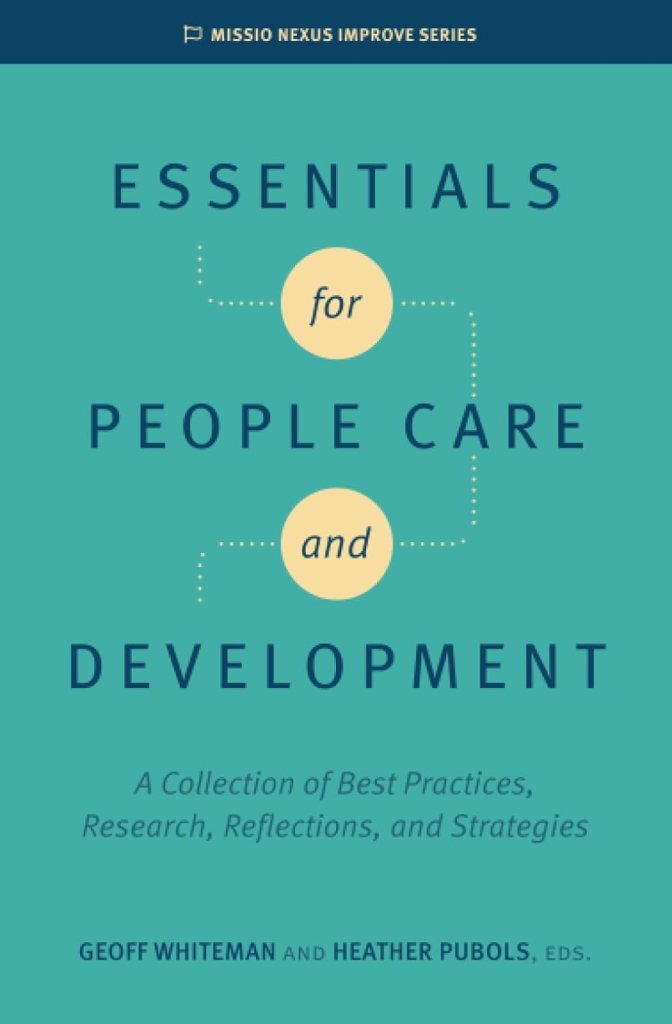
Essentials for People Care and Development: A Collection of Best Practices, Research, Reflections, and Strategies

Great new multi-author member care work in the Missio Nexus Improve Series, by Geoff Whiteman (Author) and Heather Pubols (Editor). Sara and Jeff contributed 2 chapters addressing the urgency and vital practice of effective Sabbatical: Reframing Sabbatical Posture in the Post-pandemic Landscape; and Reframing Sabbatical Posture: Embodied and Developmental. This is a must-have work for those in member care, and those leading and caring for people well…

You can purchase directly ON SALE from The Way Between here or on Amazon or digitally from MissioNexus

Season 4 Episode 10: Chronic Depression with Dr. Lee Long. A Cognitive Behavior Analysis System of Psychotherapy (CBASP) Approach.

Join Brandi and James as they interview Dr. Lee Long, discussing chronic depression and the treatment modality of CBASP. This relatively new and foundational approach to treating chronic depression helps clients navigate fear avoidance and perceptual disconnection. This is primarily accomplished through two goals of CBASP of felt didactic safety and perceived functionality. This approach can be helpful for cross-cultural clients struggling with chronic depression. Find out more at http://www.cbasp.org/psy.htm.

Dr. Lee Long, Ed.D., LPC-S, a leading figure in mental health with over two decades of experience, is known for his extensive work ranging from juvenile detention centers, psychiatric hospitals, and outpatient care. Currently at he is the President and CEO of Restoration, a multi-site outpatient practice in North Texas, Dr. Long integrates evidence-based methods to assist those battling depression, addiction, suicidal ideation, and other mental health concerns. Among the evidence-based approaches that are utilized by Dr. Long include DBT (Dialectical Behavioral Therapy) a method used for treating under-regulated emotions and CBASP (Cognitive Behavior Analysis System of Psychotherapy) a novel method for the treatment of chronic depression. His academic pursuits led him to a doctorate in Counseling, focusing on Traumatology, preparing him to address the complexities of mental health with individuals and groups alike. Dr. Long is a certified CBASP Professional. He has worked alongside Dr. James P. McCullough, Jr. in beginning the dismantling of the Cognitive Behavioral Analysis System of Psychotherapy. Their work is published in the Journal of Cognitive Therapy and Research. As a seasoned therapist and scholar, Dr. Long is committed to ongoing learning, patient care, and mentoring the next generation in effective mental health practices.

You can get in touch with Dr. Long and his counseling practice here: restorationcec.com and here restorationbeyondthecouch.com

Jim McCoulough, the founder’s books on Amazon.

Season 4 Episode 9: Book Club! Emotionally Healthy Spirituality for Cross-Cultural Workers

Join Brandi and James as they share thoughts from Pete Scazzaro’s book Emotionally Healthy Spirituality. They discuss the book’s principles and practices and how they apply to cross-cultural workers.

Family Retreat Activities: Here are some activities for families to do together, including a family genogram.

Here is a resource for anyone who would like to do a supervision genogram.

A deeper dive into making your own genogram

Peter Scazzero learned the hard way: you can’t be spiritually mature while remaining emotionally immature. Even though he was the pastor of a growing church, he did what most people do–avoid conflict in the name of Christianity; ignore his anger, sadness, and fear; use God to run from God; and live without boundaries.

Eventually God awakened him to a biblical integration of emotional health and the spiritual practice of slowing down and quieting your life for to experience a firsthand relationship with Jesus. It created nothing short of a spiritual revolution in Scazzero, in his church, and now in thousands of other churches.

In his updated edition, Scazzero shares new stories and principles as he outlines his journey and the signs of emotionally unhealthy spirituality. Then, he provides seven biblical, reality-tested steps to become emotionally mature:

Season 4: Episode 8. Velvet Ashes with Danielle Wheeler

Editor’s note (The sound quality improves after about 15 minutes)

Join Brandi and James as they interview Danielle Wheeler, the founder of Velvet Ashes. They talk about the unique experiences of women serving cross-culturally and the loneliness and isolation that can be a hallmark of the experience.

Danielle Wheeler is a spiritual director and the founder of Velvet Ashes, a community for women serving cross-culturally. She and her family served in China from 2006-2015. She is the director of spiritual formation for Velvet Ashes, leading spiritual retreats and formation practices. She lives near Joplin, Missouri with her husband, their four children, and a cat-sized dog. You can find out more about Velvet Ashes and Daniell’s ministry here

https://velvetashes.com

Retreats- https://grow.velvetashes.com/product-category/retreat/

Membership- https://grow.velvetashes.com/join/#signup

https://www.olivedirection.com

Season 4 Episode 7: Working with Cross-Cultural Teams with Stephanie Schwarz

Join Brandi and James as they talk to Stephanie Schwarz. She is a Registered Psychologist working with individuals, families, couples, and children. She enjoys building relationships in communities, connecting with schools, providing supervision, and supporting people negotiating international transitions. Today the conversation is about the challenges with cross-cultural teams. This includes navigating conflict and much more.

Culture Value Cards

These cards were created by Stephanie Schwarz to help have valuable conversations about some of the values that need navigating cross-culturally. These would be a great resource to use in training or developing new staff who are about to be working cross-culturally. This includes traditional expatriate staff and local staff new to working in an international organization. Contact her at stephanie.schwarz@sim.org.

The Peace Maker

Ken Sande presents practical biblical guidance for conflict resolution that takes you beyond resolving conflicts to true, life-changing reconciliation with family, coworkers, and fellow believers.

Peace Wise

A peacemaker is someone who is equipped to bring peace to conflict, restoration to damaged relationships, and the hope of Jesus in difficult situations. Peace Wise helps individuals, organisations and communities learn life-changing biblical peacemaking principles and build cultures of peace.

We invite you to join us in this journey.
https://peacewise.org.au/

Season 4 Episode 6: Attachment Styles and Our relationship to God with Dr. Ted Wueste

Join Brandi and James as they interview Dr. Ted Wueste on Attachment Theory and how it impacts our relationship with God. You can find more about Ted at https://desertdirection.com.

“attachment theory, in developmental psychology, the theory that humans are born with a need to form a close emotional bond with a caregiver and that such a bond will develop during the first six months of a child’s life if the caregiver is appropriately responsive.”- John Bowlby

When discussing attachment, we are talking about something that is part of God’s design in how he made us. Jesus, in scripture, has all of the commands summed up into loving God and loving each other. This is attachment and a bond between people. Being made in the image of God, the Trinity, is to have the ability to bond and connect in the same way. Attachment theory can give people a better handle on what God is talking about with the word love. This word is Hesed (חָסַד )in Hebrew and is often translated as Loving Kindness. Attachment theory is incredibly helpful for those seeking to walk with God to understand how. – Ted Wueste

“Are you tired? Worn out? Burned out on religion? Come to me. Get away with me and you’ll recover your life. I’ll show you how to take a real rest. Walk with me and work with me—watch how I do it. Learn the unforced rhythms of grace. I won’t lay anything heavy or ill-fitting on you. Keep company with me and you’ll learn to live freely and lightly.” –  Jesus, Matthew 11:28-30 (MSG)

Krispin Mayfield, in Attached to God, suggests that ambivalent, avoidant, and disorganized attachments can be understand as relating to God … 

  • Anxious attachment/spirituality
  • Shut-down attachment/spirituality
  • Shame-Filled attachment/spirituality

The movement toward secure attachment to God (grace, safety, freedom) (Mayfield):

  • From anxiety to rest
  • From shut-down to engagement
  • From shame to delight

Season 4 Episode 5: Addictions with Verne Salter

Brandi and James welcome Verne Salter to discuss addiction and its impact on cross-cultural workers. One of the bigger factors is that whatever is dealt with in our home context gets intensified when moving cross-culturally. This also may be complicated by the loss of healthy anchors. The result is issues that might only be minor or are well handled in the home context but can be systemically problematic cross-culturally.

Get in touch with Verne https://www.smithandsalter.com/about or check out MTI at https://www.mti.org

Vern Salter – MA, LPCC

Vern has spent over 25 years as a vocational christian worker, both stateside and overseas.

Having received help and care in times of crises, he values the “below the waterline” work of counseling, as well as the “at the waterline” work of adopting soul care practices, relational reconciliation, and healthy rhythms in life.

With an MA in Clinical Counseling from Colorado Christian University, Vern blends professional and soul care in his perspective on providing care.

Trained in EMDR, Gottman Marriage Therapy, and Soul Care, he brings a broad scope to member care work.

He is married to Janell, and they have 3 adult children. Living in Colorado Springs, CO, they marvel at the beauty of God’s creation around them daily.

Season 4 Episode 4: Missional Resilience with Goeff Whiteman; Listening to Member Care.

Brandi and James welcome back Geoff Whiteman, ThM, LMFT, to discuss missional resilience and what he has learned from his most recent study listening to member care professionals. You can learn more and get in touch with Geoff at www.resilientglobalworker.org

“At the end of our grit, missional resilience really flourishes, and we come to the end of ourselves. It’s as if then our hands are open to receive Jesus’ resilience” -Geoff

We made preventing attrition the goal for member care, which misses the mark. Preventable attrition isn’t a way to ‘score a point’ but to ‘lose a point’, then suddenly the field of play is very small and possessive. It becomes a game we cannot win but can only lose. Attrition is the wrong measurement of success and failure, especially for staff care. Taking an internal responsibility for something outside of one’s control results in wounding or pain over which we do not have responsibility. For example, someone we care for leaves. This is a form of moral injury, and that pain is really painful for staff care providers.

Flourishing is a better benchmark for measuring the success of staff care. Navigating the liminal spaces of flourishing and challenge is a far better goal and direction for staff care providers.

Season 4 Episode 3: TCK Educational Needs with Bethany Walker

Bethany Walker is currently the curriculum director of an online Christian school called Norhtline Academy, which has been serving global workers for over 25 years. She has extensive experience teaching, developing curriculum, and living cross-culturally. You can read more about her here.

Families are going to have unique needs, and those pieces of resourcing are so important. Organizations need to anticipate those needs to the best of their ability. – Bethany Walker

Resource

Visit SHARE.. “We help English-speaking families serving in Europe, Central Asia, and the Middle East with their children’s educational needs.”

Season 4 Episode 2: Talkin’ ’bout my g g g… Sandwich Generation with Hannele Secchi

Hannele Secchia serves with SIL in Ethiopia, where she grew up and has lived and worked for the last 15 years. In Ethiopia, she has served SIL, Bingham Academy, and the broader cross-cultural community in a variety of care-oriented ways. Currently, she is the President of Families in Global Transition.

The Sandwich Generation

“This is the generation of people between having aging parents and children that they are launching out of the home.”

According to PEW Research based in the USA, About three-in-ten U.S. adults (29%) have a child younger than 18 at home, and 12% of these parents provide unpaid care for an adult as well. All told, these multigenerational caregivers provide more than two and a half hours of unpaid care a day, on average, according to a new Pew Research Center analysis of Bureau of Labor Statistics data. https://www.pewresearch.org/short-reads/2018/11/29/more-than-one-in-ten-u-s-parents-are-also-caring-for-an-adult/

Sandwich, panini, seven-layer dip?

For years, the term sandwich generation has generally been applied to adults (mostly women) taking care of their aging parents and their minor children at the same time. Bulson feels the same exhaustion and frustration and faces a similar lack of societal support, but she’s part of a less-recognized group: people who are taking care of their aging parents and are still supporting adult kids — at home or otherwise (sometimes referred to as the “club sandwich generation”). Another oft-overlooked group is people who are caring for their aging parents and helping out with their grandchildren (a.k.a. the “grand-sandwich generation”). https://www.washingtonpost.com/parenting/2023/03/22/caregivers-sandwich-generation/

Season 4 Episode 1: The Transition of Retirement with Shonna Ingram

Join Brandi and James as they interview Shonna Ingram about transitions and retirement. It can often be a taboo subject but can be an opportunity to celebrate a different life stage and is worth planning for.

“Retirement is a hard transition for people. It may not be only the re-entry or retirement issue; it could be some of the other layers connected to the process, too.”

Shonna Ingram is an experienced practitioner and trainer, working with cross-cultural workers. She found herself becoming an expert in life transitions over the past 15 years. Recently, she has been asked outside the cross-cultural worker’s circle for resources she has been providing for years. This led her to create the Renewed Hope Approach

Amid the complexities of life, trauma can cast its shadow in various forms. At Shonna Ingram Consulting, we recognize the vital importance of integrating Christian faith with trauma-informed care. Our approach acknowledges that healing and renewal extend beyond addressing the mind alone. By combining mental health principles with the transformative power of Biblical teachings, we bridge the gap between understanding and healing. In a world that’s no stranger to pain and uncertainties, our commitment is to offer a safe haven where faith and practical solutions converge, leading to holistic recovery. Explore the need for Christian trauma-informed care and discover the path to renewed hope.

Visit her website to learn more! https://shonnaingram.com/

Season 3 Episode 12: 2023 Wrap up

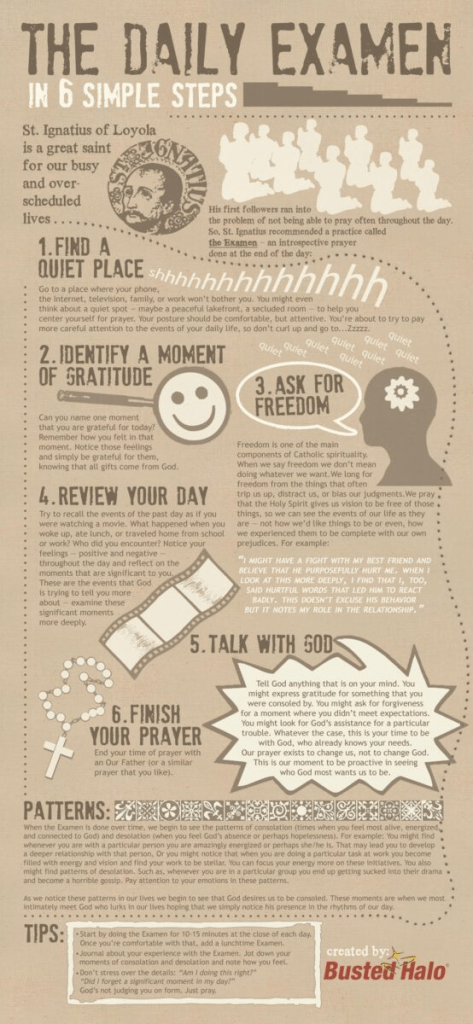
Join Brandi and James as they wrap up 2023 with some highlights, trends, and what they look forward to next year. One way to incorporate this same idea yourself or with your family would be through the practice of an Examen. Pausing to notice the highs and lows of the year and to write down things that are worth holding on to.

Resources

The Ignatian Examen

St. Ignatius invites us to find God in all things. That means we have to pay careful attention to how the Spirit is moving in each moment of our daily lives. We have to take a magnifying glass to the seemingly ordinary, seeking to encounter the Divine. 

That’s why the Examen is such a powerful prayer. In it, we’re invited to encounter God, express gratitude for the gift and gifts of each day, and to commit to make up for any mistakes we may have made. 

The Examen is a flexible prayer, too, responding to the signs of the times. Below, you’ll find several variations to meet your need in this moment

Ignatian Exercises


Essentials for People Care and Development

Practical insights and activities to help your organization build a thriving culture.

Finding, sending, and caring for missionaries has grown increasingly complex for mission leaders and staff. The mission world is more multicultural and global crises seem to be more frequent. And we can no longer make the same assumptions about shared values which can open the door for legal difficulties. We all want to see ministry staff thriving and serving the kingdom to their full potential, but how can we support that? In this book, you will be able to dig deeper into these fundamental issues and more.

Member care workers collaborated with us to bring practical insights that will help you and your agencies. No matter where you fit on the spectrum of care – a concerned pastor, missionary colleague, or ministry leader all the way to a professional services provider – this book and its contents will help you implement improvements in caring for ministry staff.

Leave a comment

Season 3 Episode 11: Mindfulness with Bethann Miller

Bethann is the co-founder and CEO of Safe Place, a ministry that provides support, training, care, and guidance to folks serving in Christ-centered ministry throughout the world. She is also a licensed chaplain, board-certified pastoral counselor, and author of “The Invitation,” a handbook that sets the stage for couples to engage in deeper relational connection.

After serving for over 30 years in full time ministry and traveling to over 53 countries, it is Bethann’s joy to support pastors, missionaries, and leaders in that to which they have set their hands. Beyond this, Bethann can be found either out riding her motorcycle ‘Pearl’ or at home with her husband Tom and their two cats watching the national football league channel.

Season 3 Episode 10: Short-Term Teams with Andrea Kroeze

Join Brandi and James as they talk about Short-Term teams with Andrea Kroeze. Andrea serves with Touch The World, offering training and development for short-term projects, teams, or individuals doing short-term cross-cultural ministry. https://touchtheworld.org

Through The Missions Academy, you will be equipped with:

  1. A Biblical understanding of missions
  2. Methods for culturally sensitive ministry
  3. An understanding of the complexities of poverty
  4. A heart focused on service

https://learn.themissionsacademy.com/

Contact Andrea andreak@touchtheworld.org

Season 3 Episode 9: Autism and Neurodivergence among Cross-Cultural Workers and their Families.

Join Brandi and James as they interview Chyrl Mullins, an Educational Consultant with Wycliffe. They talk about Autism spectrum signs, symptoms, and treatments. They also look at how to navigate the world of ASD from the perspective of families and co-workers. Understanding more about neurodivergence and the range of experience with ASD increases the grace and capacity of neurotypical people in their families and communities.

https://my.clevelandclinic.org/health/symptoms/23154-neurodivergent

https://www.autismspeaks.org/what-autism

Season 3 Episode 8: Expectations

  • Be aware of the “Shoulds” that can control your life.
  • “All of life’s frustrations come from unmet expectations“- Dr. John Lund
  • Cross Cultural Servanthood by Duane Elmer
  • Atlas of the Heart by Brene Brown

Cross-Cultural Worker Expectations Worksheet – by James Covey, MA LPC-S

Step 2: Invitations

Internal Expectations

A) Give grace to myself or others. Is my expectation unrealistic? Is this person
able to give me what I need at this time? Do my expectations need to be
adjusted?
B) Release, surrender or grieve an unmet expectation. Do I need to release the
timing of something, confess an unrealistic standard, release the way I think
something should be done, need to suspend judgment about a person or
situation, people group, or grieve that I may not see that expectation fulfilled?
C) Explore deeper healing around a theme. I am aware this expectation is linked
to an area where I need healing. As God has raised my awareness this week, I
want to surrender to Him anew AND have a conversation with someone about
how to pursue healing more deeply.
D) Praise God for His mercy. I’m realizing my expectations have been exceeded
in some areas! I want to take some time to worship and thank Him for His
kindness to me.
E) Redirect my misplaced hopes towards God. I’m realizing how externally
focused I am on getting my needs and desires met. The Lord is inviting me to
release others and turn my focus back on Him as the source of my hope.

External invitations
1) Help in the fog. I don’t know if my expectation is realistic OR I can’t find the
expectation or don’t know how to resolve an unmet expectation. I need someone
to help me explore what is happening on a particular situation.
2) Call to action. Do I need to clarify an expectation with others, have a
conversation about my disappointment, or mirror back to someone a theme I see
in someone’s life around expectations?
3) I need others. This expectation is realistic but I’m having trouble moving
forward. I may be hitting a deeply ingrained attitude or behavior OR see this as
an issue of character development. I need coaching, accountability, prayer, or
counsel.

Make Adjustments Step 3

  • Having done the internal and external invitations; now I need to rewrite or adjust my
    expectations. Changing the expectations to live in the reality of what is now (Step 3)

Season 3 Episode 7: Trauma-Informed Staff Care

What is Trauma? 

“Trauma is a deep wound of the heart and mind that takes a long time to heal. It hurts every part of our lives: how we relate to others, how our body feels, what we think about, and how much we can trust God. It can make us feel separated from God and others” – Trauma Healing Institute 

Further Reading and Learning:

  • The Body Keeps The Score by  Bessel van der Kolk
  • The Trauma Healing Institute

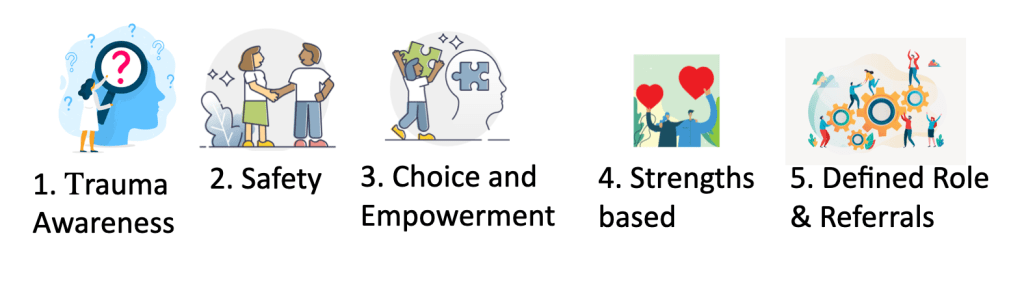
Trauma-Informed Staff Care

  1. Increased Trauma Awareness 
    1. Realize the widespread impact of trauma and understand paths for recovery
    1. Recognize the signs and symptoms of trauma
    1. Actively avoid re-traumatization
  2. Provide Safety 
    1. Provide avenues for psychological safety
    1. Mitigate power differentials
    1. Integrate knowledge about trauma into policies, procedures, and practices
  3. Empower People to Make Choices 
    1. Look
    1. Listen
    1. Link
  4. Focus on Strengths 
    1. Coach don’t counsel
    1. Be vulnerable, because it lowers our amour and that of those around us. 
    1. Normalize and Affirm 
  5. Understand Roles and Make Referrals 
    1. Who is my client and What is my role?
    1. Acknowledge and reframe (emotions are ok, behavior may not be)
    1. Coach towards help and make referrals

Further Reading and Learning: 

New Book!

Essentials for People Care and Development: A Collection of Best Practices, Research, Reflections, and Strategies (Missio Nexus Improve Series):
by  Geoff Whiteman  (Author), Heather Pubols  (Editor) Buy it now on Amazon

Season 3 Episode 6: Compassion Fatigue with Mark Ventrella

Compassion Fatigue

“It is impossible to be close to suffering and not be impacted by it” – Mark Ventrella.

“Most healthcare providers enter the field with the intent to help others and provide empathic care for patients with critical physical, mental, emotional, and spiritual needs. Healthcare providers, however, can be impacted by the continuing stress of meeting the often overwhelming needs of patients and their families which may result in compassion fatigue. ” https://proqol.org

One could easily substitute Cross-Cultural workers for health care providers in this definition as often they are in positions of caring for those around them. The ProQOL is an excellent source for assessing burnout, compassion fatigue, and compassion satisfaction.

 Professional Quality of Life (proQOL) is intended for any helper – cross-cultural workers, health care professionals, social service workers, teachers, attorneys, emergency response, etc. Understanding the positive and negative aspects of helping those who experience trauma and suffering can improve your ability to help them and your ability to keep your own balance.   https://proqol.org

Season 3 Episode 5: Emotional Intelligence

Join Brandi and James as they discuss emotional intelligence, what it is and why it is important for cross cultural workers and organizations to be emotionally intelligent.

Daniel Goleman, the author of Emotional Intelligence, defined emotion as “referring to a feeling and its distinctive thoughts, psychological and biological states, and range of propensities to act.” What he meant is that God created human beings to feel a wide range of emotions. (Pete Scazzaro)

By teaching people to tune in to their emotions with intelligence and to expand their circles of caring, we can transform organizations from the inside out and make a positive difference in our world –Daniel Goleman

Window of Tolerance

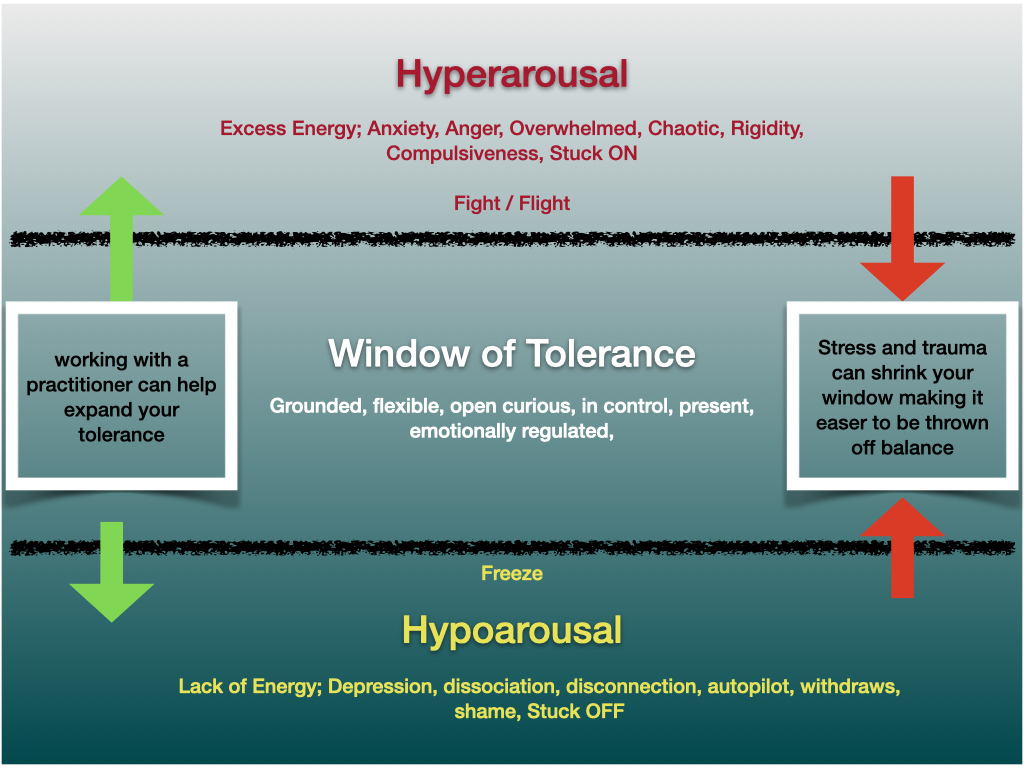
The Window of Tolerance is a model founded in Neuroscience (the scientific study of the nervous system), which helps develop good practice for improving and maintaining mental health and wellbeing.

It offers a way of thinking about how we function optimally, in our various roles, and how to manage when heightened emotions begin to have a negative impact.

Developed by Dan Siegel, a Clinical Professor of Psychiatry, the Window of Tolerance describes the best state of ‘arousal’ or stimulation in which we are able to function and thrive in everyday life. When we exist within this window, we are able to learn effectively, play, and relate well to ourselves and others.

Season 3 Episode 4: The Rise of Teenage Anxiety with Brianna White, LMFT

Join Brandi and James as they talk with Brianna White, Licensed Marriage and Family Therapist about anxiety in teenagers, specifically Third Culture Kids. Brianna said;

“we all need to remember that anxiety is a body reaction to a challenge we are facing. It can be really uncomfortable but that doesn’t mean its bad or dangerous and that it is ok to feel anxious.”

And for TCK’s that ,

“Common sense only is only common if you have common experience”

Breanna is an adult Third Culture Kid who grew up in Ukarumpa, Papua New Guinea. While there, she saw first hand how important it is for teens to have access to mental health care wherever they are. That inspired her to become a counselor. After graduating from Ukarumpa International High School, She obtained a B.A. in Psychology from Taylor University, and then a Masters of Science in Marriage and Family Therapy from Fuller Graduate School of Psychology at Fuller Theological Seminary. Now she is a Licensed Marriage and Family Therapist and Child Mental Health Specialist.

Season 3 Episode 3: Navigating the Neutral Zone with Dr. Stephen Jones

Why do they call it the neutral zone?? it doesn’t feel neutral at all its just hard! Join Brandi and James as they talk to Dr. Stephen Jones about his research, books and personal experience with navigating transition. They cover the range of the transition experience and talk tools and practical steps for healthy transitions. Imagine if one can only function at 70-80% of your underlying capacity when living cross culturally what does accounting for that difference look like?

Stephen W. Jones is father of three and husband of one. He works to see transformation in the lives of individuals, communities, and the world. He yearns to see beauty rise out of pain, and believes that rooting lives in eschatological hope sets people free.

Jones teaches, trains, and studies at the intersection of intercultural relations, cross-cultural ministry, and political science. He is a Ph.D. Candidate in International Development at the University of Southern Mississippi and earned his M.A. in Intercultural Relations from the University of the Pacific, in conjunction with the Intercultural Communication Institute.

He was formerly Assistant Professor of International Studies at Crown College in Minnesota, where he oversaw the Center for Global Engagement and the International Relations (B.A.) and Intercultural Youth Development (B.S.) majors.

Podcasts by Stephen:

Books by Stephen:

Season 3 Episode 2: Women in Cross-Cultural Ministry with Amy Galloway

Join Brandi and James as they welcome Amy Galloway to talk about the roles of women in cross-cultural ministry. The topics range from how to create organizational change towards a minority (30% must be represented for change to happen) to the development traits women experience at different points in their journeys.

Amy Galloway has an undergraduate degree in International Studies and a masters in Communication, both from the University of Denver. She has spent the the last decade helping Novo walk through a cultural transition to increase gender diversity among their leaders. Now her primary focus is writing, leading retreats, and visioneering an activation/development branch from Malaga Spain with Sentwell.org. Amy contributions to the team includes through her communication gifting and heart for prayer. She coaches and trains in the discovery of calling and navigating major transitions in vocation, parenting, transitions, and women in leadership.

Amy writes a blog on life transitions called Beautiful Upheaval, where this reflection was originally posted.