Season 4 Episode 9: Book Club! Emotionally Healthy Spirituality for Cross-Cultural Workers

Join Brandi and James as they share thoughts from Pete Scazzaro’s book Emotionally Healthy Spirituality. They discuss the book’s principles and practices and how they apply to cross-cultural workers.

Family Retreat Activities: Here are some activities for families to do together, including a family genogram.

Here is a resource for anyone who would like to do a supervision genogram.

A deeper dive into making your own genogram

Peter Scazzero learned the hard way: you can’t be spiritually mature while remaining emotionally immature. Even though he was the pastor of a growing church, he did what most people do–avoid conflict in the name of Christianity; ignore his anger, sadness, and fear; use God to run from God; and live without boundaries.

Eventually God awakened him to a biblical integration of emotional health and the spiritual practice of slowing down and quieting your life for to experience a firsthand relationship with Jesus. It created nothing short of a spiritual revolution in Scazzero, in his church, and now in thousands of other churches.

In his updated edition, Scazzero shares new stories and principles as he outlines his journey and the signs of emotionally unhealthy spirituality. Then, he provides seven biblical, reality-tested steps to become emotionally mature:
Season 4 Episode 7: Working with Cross-Cultural Teams with Stephanie Schwarz

Join Brandi and James as they talk to Stephanie Schwarz. She is a Registered Psychologist working with individuals, families, couples, and children. She enjoys building relationships in communities, connecting with schools, providing supervision, and supporting people negotiating international transitions. Today the conversation is about the challenges with cross-cultural teams. This includes navigating conflict and much more.

Culture Value Cards

These cards were created by Stephanie Schwarz to help have valuable conversations about some of the values that need navigating cross-culturally. These would be a great resource to use in training or developing new staff who are about to be working cross-culturally. This includes traditional expatriate staff and local staff new to working in an international organization. Contact her at stephanie.schwarz@sim.org.

The Peace Maker

Ken Sande presents practical biblical guidance for conflict resolution that takes you beyond resolving conflicts to true, life-changing reconciliation with family, coworkers, and fellow believers.

Peace Wise

A peacemaker is someone who is equipped to bring peace to conflict, restoration to damaged relationships, and the hope of Jesus in difficult situations. Peace Wise helps individuals, organisations and communities learn life-changing biblical peacemaking principles and build cultures of peace.

We invite you to join us in this journey.
https://peacewise.org.au/

Season 4 Episode 5: Addictions with Verne Salter

Brandi and James welcome Verne Salter to discuss addiction and its impact on cross-cultural workers. One of the bigger factors is that whatever is dealt with in our home context gets intensified when moving cross-culturally. This also may be complicated by the loss of healthy anchors. The result is issues that might only be minor or are well handled in the home context but can be systemically problematic cross-culturally.

Get in touch with Verne https://www.smithandsalter.com/about or check out MTI at https://www.mti.org

Vern Salter – MA, LPCC

Vern has spent over 25 years as a vocational christian worker, both stateside and overseas.

Having received help and care in times of crises, he values the “below the waterline” work of counseling, as well as the “at the waterline” work of adopting soul care practices, relational reconciliation, and healthy rhythms in life.

With an MA in Clinical Counseling from Colorado Christian University, Vern blends professional and soul care in his perspective on providing care.

Trained in EMDR, Gottman Marriage Therapy, and Soul Care, he brings a broad scope to member care work.

He is married to Janell, and they have 3 adult children. Living in Colorado Springs, CO, they marvel at the beauty of God’s creation around them daily.

Season 3 Episode 11: Mindfulness with Bethann Miller

Bethann is the co-founder and CEO of Safe Place, a ministry that provides support, training, care, and guidance to folks serving in Christ-centered ministry throughout the world. She is also a licensed chaplain, board-certified pastoral counselor, and author of “The Invitation,” a handbook that sets the stage for couples to engage in deeper relational connection.

After serving for over 30 years in full time ministry and traveling to over 53 countries, it is Bethann’s joy to support pastors, missionaries, and leaders in that to which they have set their hands. Beyond this, Bethann can be found either out riding her motorcycle ‘Pearl’ or at home with her husband Tom and their two cats watching the national football league channel.

Season 3 Episode 9: Autism and Neurodivergence among Cross-Cultural Workers and their Families.

Join Brandi and James as they interview Chyrl Mullins, an Educational Consultant with Wycliffe. They talk about Autism spectrum signs, symptoms, and treatments. They also look at how to navigate the world of ASD from the perspective of families and co-workers. Understanding more about neurodivergence and the range of experience with ASD increases the grace and capacity of neurotypical people in their families and communities.

https://my.clevelandclinic.org/health/symptoms/23154-neurodivergent

https://www.autismspeaks.org/what-autism

Season 3 Episode 7: Trauma-Informed Staff Care

What is Trauma? 

“Trauma is a deep wound of the heart and mind that takes a long time to heal. It hurts every part of our lives: how we relate to others, how our body feels, what we think about, and how much we can trust God. It can make us feel separated from God and others” – Trauma Healing Institute 

Further Reading and Learning:

  • The Body Keeps The Score by  Bessel van der Kolk
  • The Trauma Healing Institute

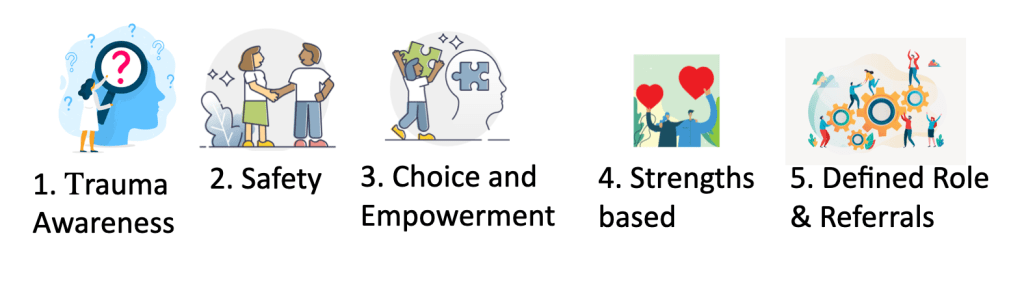
Trauma-Informed Staff Care

  1. Increased Trauma Awareness 
    1. Realize the widespread impact of trauma and understand paths for recovery
    1. Recognize the signs and symptoms of trauma
    1. Actively avoid re-traumatization
  2. Provide Safety 
    1. Provide avenues for psychological safety
    1. Mitigate power differentials
    1. Integrate knowledge about trauma into policies, procedures, and practices
  3. Empower People to Make Choices 
    1. Look
    1. Listen
    1. Link
  4. Focus on Strengths 
    1. Coach don’t counsel
    1. Be vulnerable, because it lowers our amour and that of those around us. 
    1. Normalize and Affirm 
  5. Understand Roles and Make Referrals 
    1. Who is my client and What is my role?
    1. Acknowledge and reframe (emotions are ok, behavior may not be)
    1. Coach towards help and make referrals

Further Reading and Learning: 

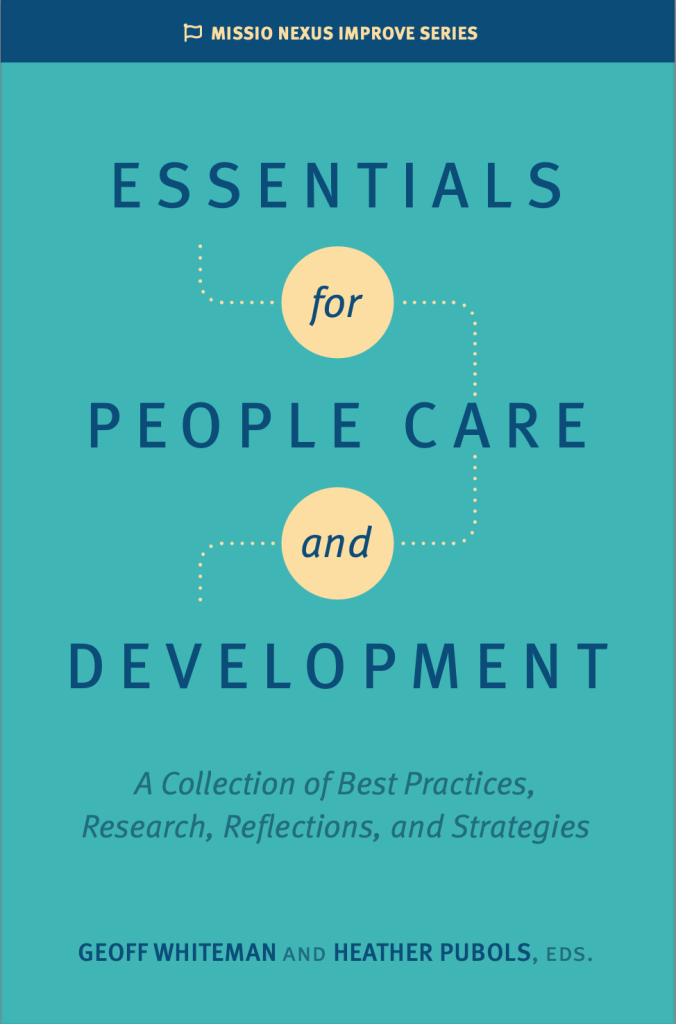
New Book!

Essentials for People Care and Development: A Collection of Best Practices, Research, Reflections, and Strategies (Missio Nexus Improve Series):
by  Geoff Whiteman  (Author), Heather Pubols  (Editor) Buy it now on Amazon

Season 3 Episode 6: Compassion Fatigue with Mark Ventrella

Compassion Fatigue

“It is impossible to be close to suffering and not be impacted by it” – Mark Ventrella.

“Most healthcare providers enter the field with the intent to help others and provide empathic care for patients with critical physical, mental, emotional, and spiritual needs. Healthcare providers, however, can be impacted by the continuing stress of meeting the often overwhelming needs of patients and their families which may result in compassion fatigue. ” https://proqol.org

One could easily substitute Cross-Cultural workers for health care providers in this definition as often they are in positions of caring for those around them. The ProQOL is an excellent source for assessing burnout, compassion fatigue, and compassion satisfaction.

 Professional Quality of Life (proQOL) is intended for any helper – cross-cultural workers, health care professionals, social service workers, teachers, attorneys, emergency response, etc. Understanding the positive and negative aspects of helping those who experience trauma and suffering can improve your ability to help them and your ability to keep your own balance.   https://proqol.org

Season 3 Episode 5: Emotional Intelligence

Join Brandi and James as they discuss emotional intelligence, what it is and why it is important for cross cultural workers and organizations to be emotionally intelligent.

Daniel Goleman, the author of Emotional Intelligence, defined emotion as “referring to a feeling and its distinctive thoughts, psychological and biological states, and range of propensities to act.” What he meant is that God created human beings to feel a wide range of emotions. (Pete Scazzaro)

By teaching people to tune in to their emotions with intelligence and to expand their circles of caring, we can transform organizations from the inside out and make a positive difference in our world –Daniel Goleman

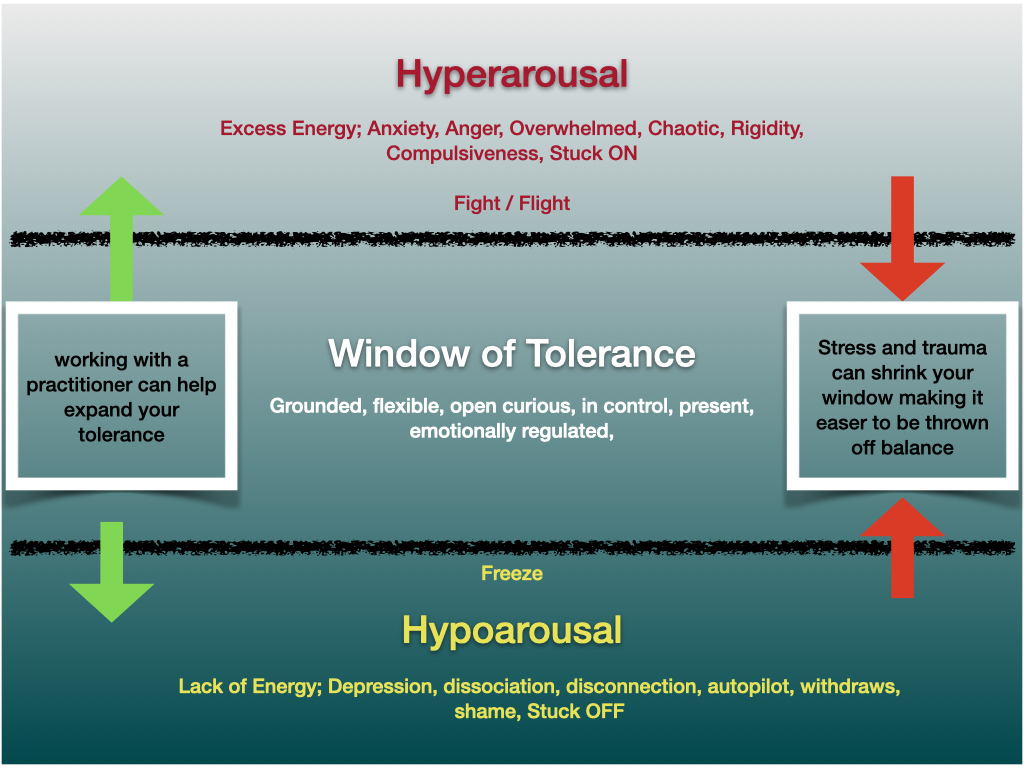
Window of Tolerance

The Window of Tolerance is a model founded in Neuroscience (the scientific study of the nervous system), which helps develop good practice for improving and maintaining mental health and wellbeing.

It offers a way of thinking about how we function optimally, in our various roles, and how to manage when heightened emotions begin to have a negative impact.

Developed by Dan Siegel, a Clinical Professor of Psychiatry, the Window of Tolerance describes the best state of ‘arousal’ or stimulation in which we are able to function and thrive in everyday life. When we exist within this window, we are able to learn effectively, play, and relate well to ourselves and others.

Season 3 Episode 3: Navigating the Neutral Zone with Dr. Stephen Jones

Why do they call it the neutral zone?? it doesn’t feel neutral at all its just hard! Join Brandi and James as they talk to Dr. Stephen Jones about his research, books and personal experience with navigating transition. They cover the range of the transition experience and talk tools and practical steps for healthy transitions. Imagine if one can only function at 70-80% of your underlying capacity when living cross culturally what does accounting for that difference look like?

Stephen W. Jones is father of three and husband of one. He works to see transformation in the lives of individuals, communities, and the world. He yearns to see beauty rise out of pain, and believes that rooting lives in eschatological hope sets people free.

Jones teaches, trains, and studies at the intersection of intercultural relations, cross-cultural ministry, and political science. He is a Ph.D. Candidate in International Development at the University of Southern Mississippi and earned his M.A. in Intercultural Relations from the University of the Pacific, in conjunction with the Intercultural Communication Institute.

He was formerly Assistant Professor of International Studies at Crown College in Minnesota, where he oversaw the Center for Global Engagement and the International Relations (B.A.) and Intercultural Youth Development (B.S.) majors.

Podcasts by Stephen:

Books by Stephen:

Season 3 Episode 2: Women in Cross-Cultural Ministry with Amy Galloway

Join Brandi and James as they welcome Amy Galloway to talk about the roles of women in cross-cultural ministry. The topics range from how to create organizational change towards a minority (30% must be represented for change to happen) to the development traits women experience at different points in their journeys.

Amy Galloway has an undergraduate degree in International Studies and a masters in Communication, both from the University of Denver. She has spent the the last decade helping Novo walk through a cultural transition to increase gender diversity among their leaders. Now her primary focus is writing, leading retreats, and visioneering an activation/development branch from Malaga Spain with Sentwell.org. Amy contributions to the team includes through her communication gifting and heart for prayer. She coaches and trains in the discovery of calling and navigating major transitions in vocation, parenting, transitions, and women in leadership.

Amy writes a blog on life transitions called Beautiful Upheaval, where this reflection was originally posted.

Season 2 Episode 9: Care During Covid; What We Learned From The Pandemic

Join Brandi and James as they discuss James’ recent research and presentation on what the global staff care and counseling community have learned from the pandemic about caring staff. Not all of the changes that have impacted our cross cultural workers have been negative and many we need to keep doing. In many ways our cross cultural workers have benefited most in some of the ways the world has responded to the mental health impacts of the pandemic. It is key for those in care positions for remote staff to capitalize on those opportunities.

4 Lessons from the Pandemic

  • Lesson 1: Virtual Engagement
  • Lesson 2: Working Remotely
  • Lesson 3: Mental Health Impacts
  • Lesson 4: Collaboration  

Click Here to View James’ Presentation

Thanks to Alex_MakeMusic from Pixabay and Dee-Yank-Kee for the free Christmas music in the podcast!

Season 2 Episode 8: Trauma with Dr. Phil Monroe

Join Brandi and James as they interview Dr. Phil Monroe with Langberg, Monroe and Associates about trauma. Dr. Philip Monroe leads Langberg, Monroe & Associates and is a psychologist with three decades of clinical experience. His personal, professional, and spiritual musings may be found at http://www.philipmonroe.com.

Trauma is a wound of the heart that affects every part of our being; our bodies, minds and hearts. It takes a long time to heal. Trauma is not an event so much as it is an experience. Trauma is the experience people have when they are overwhelmed and cannot cope. The effect someone has from that experience best defines long term trauma.”

“When we talk about trauma we are talking about an ongoing, long lasting effect. It may be soon after an event or experience or it maybe a years and decades later that it starts to show up.

Resources

Dr. Diane Langberg

  • Diane Langberg’s Youtube Channel
  • Suffering and the Heart of God (Book)
  • In our Lives First (Devotional)

Jenena Fisher

Trauma Healing Institute https://traumahealinginstitute.org

Season 2 Episode 7: Navigating the Risk in Returning with Anna Hampton

Join Brandi and James as they interview Anna Hampton, Author of Facing Danger, to talk about navigating theology of risk and the risk of returning to locations after a crisis. In the Fall of 2022 we are still navigating challenges of Russia’s war against Ukraine and other evacuations from around the globe. We strongly encourage your organization to attend their Risk Assessment and Management Training. We are excited to announce her Fear and Courage Webinar on November 16th. Sign up by emailing her at annahampton00@gmail.com.

Anna Hampton,

Anna grew up as a farm girl in the Midwest and felt called to work overseas as a young teen. By her mid-twenties, she was in full-time work leading teenagers all over the world. In 1996, she began a long-distance courtship with Neal across three continents, and after marrying in 1999, sthey began raising their family in Afghanistan. She and her husband serve with Barnabas International in pastoral care and risk consulting. They have three adult children and one daughter-in-law. 

Anna shares God’s Word interwoven with personal experiences from living and working for a decade in war-torn Afghanistan and from over twenty-seven years of ministry experiences traveling in almost seventy countries. She writes with a realism and depth from her own trials of facing overwhelming obstacles with faith and joy while also living in extremist environments for almost two decades while raising three young children. She is the author of Facing Danger: A Guide Through Risk, Facing Fear: The Journey to Mature Courage in Risk and Persecution (est 2023), and contributed to the Risk Assessment and Management (RAM) Training that Neal wrote based on her book. 

Anna holds a Master’s in Educational Leadership from Bethel University and a Doctor of Religious Studies from Trinity Theological Seminary. She is a Bible teacher and conference speaker at international women’s events in Central Asia, the Middle East, and in the US. She writes at TheologyOfRrisk.com and at Behind the Veil: A Public Journal of a Hidden Life. (http://better-than-gold-faith.blogspot.com/).

Resources

Purchase her first book Facing Danger: A Guide Through Risk. Her new book Facing Fear: The Journey to Mature Courage in Risk and Persecution Hopefully will be available late Spring 2023 or Summer 2023.

Personal Blog https://theologyofrisk.com

Website https://theologyofrisk.com

The Cry of the Soul: How Our Emotions Reveal Our Deepest Questions About God by Dan Allender and Temper Longman III

Thinking, Fast and Slow is a 2011 by psychologist Daniel Kahneman.

Season 2 Episode 3 “The Couch” with Paula Wong

Join Shop Talk with Brandi and James as they talk with Paula Wong about her work with cross cultural workers. Dr. Wong was trained in Australia and now lives in Switzerland where she covers a broad range of issues in her Counseling Practice primarily with cross cultural workers. Through her work Paula holds an unshakable hope for healing both individuals and relationships. Part of her training includes a psychoanalysis approach and sometimes she says, people need to just get on the couch!

Depression Part 2 (Episode 13)

Shop Talk with Brandi and James

In this episode Brandi and James get a little deeper into what to do about depression. One of the big keys is growing in self awareness so you know when you need help and how to get it. It is easy to ask someone to help you move because it is obviously a two person job. Dealing with the mental, emotional, physical and spiritual challenges of depression are no different.

Types of Therapy

Some types of therapy that were mentioned in this episode are:

  • CBT (Cognitive Behavior Therapy)  is a form of psychological treatment that has been demonstrated to be effective for a range of problems including depression, anxiety disorders, alcohol and drug use problems, marital problems, eating disorders, and severe mental illness. Numerous research studies suggest that CBT leads to significant improvement in functioning and quality of life. In many studies, CBT has been demonstrated to be as effective as, or more effective than, other forms of psychological therapy or psychiatric medications.
  • DBT (Dialectical Behavior Therapy) is a type of Cognitive Behavior Therapy. Its main goals are to teach people how to live in the moment, develop healthy ways to cope with stress, regulate their emotions, and improve their relationships with others
  • EMDR (Eye Movement Desensitization Reprocessing) is a psychotherapy treatment that was originally designed to alleviate the distress associated with traumatic memories (Shapiro, 1989a, 1989b). Shapiro’s (2001) Adaptive Information Processing model posits that EMDR therapy facilitates the accessing and processing of traumatic memories and other adverse life experience to bring these to an adaptive resolution. After successful treatment with EMDR therapy, affective distress is relieved, negative beliefs are reformulated, and physiological arousal is reduced.

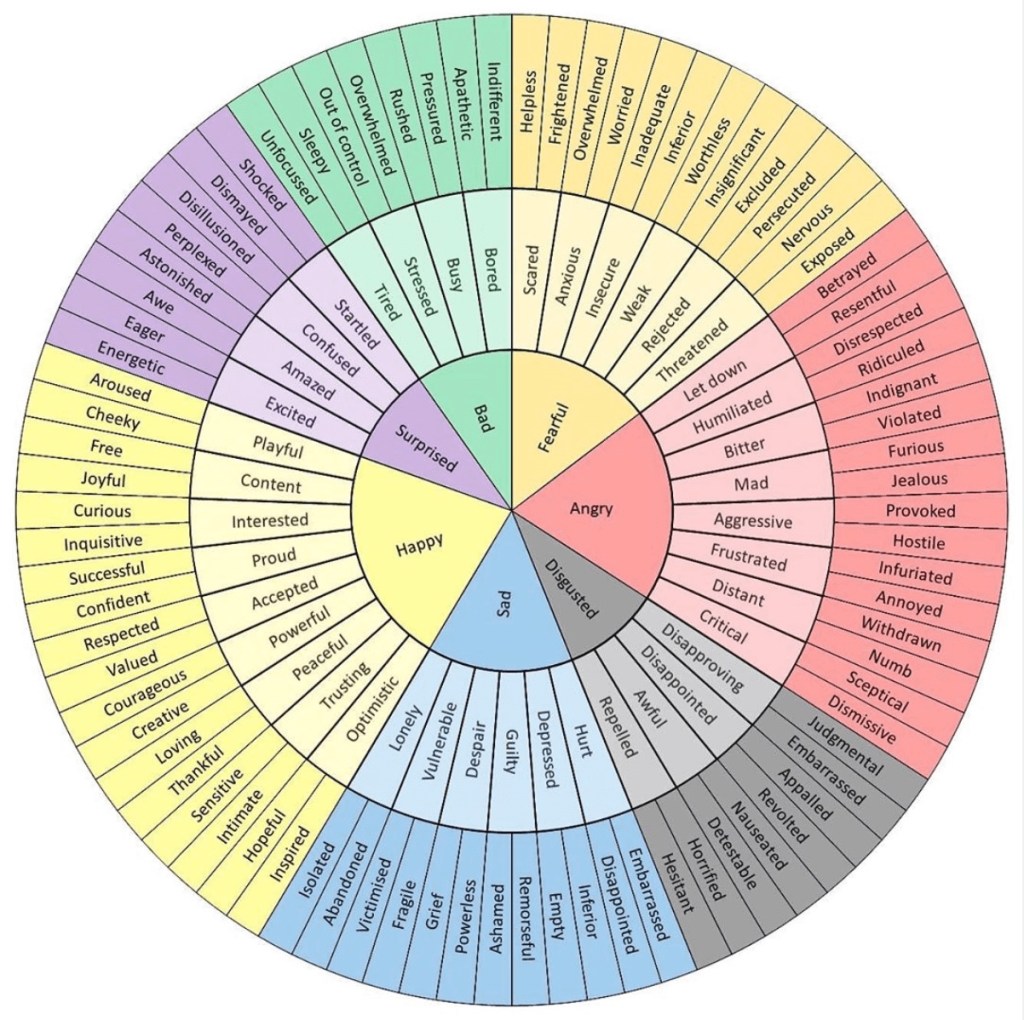
Emotion Wheel

One of the main topics was the need to grow in self awareness especially as it relates to your own emotions. This Colorful emotion wheel could be helpful for that https://fairygodboss.com/career-topics/emotion-wheel

Grief (Part 2) – Dr. Ted Wueste

Shop Talk with Brandi and James Episode 7. Listen in to part 2 of an interview with Spiritual Director Dr. Ted Wueste

One way to process your own grief is through writing of a lament. Here is one way to engage in that process.

Writing your own lament

By James Covey (adapted from Healing Teen’s Wounds of Trauma)

One positive way to deal with the hard things that go on in our lives is to create a “lament.” A lament is a way of expressing our pain to God when we feel bad. It might be done in words, in music, in dance or any other form of creative expression.

A lament helps us expose all the stuff that we have tried to hide and share it with God. This is a good way to start telling your story and releasing painful memories. As it becomes more comfortable for you to share it privately with God, creating a lament can lead to sharing your story with another person when you are ready.

There are many examples of laments in the Bible. Trauma after trauma happened to the nation of Israel as a community (wars, captivity, displacement, famines) as well as to individuals (abuse, rape, abandonment, murder). Many of them found comfort in bringing their pain to God. They had an honest way of speaking to God where they poured out their complaints to him, sometimes even as they declared their trust in him. There are over 40 laments in the book of psalms (making it the most common type of psalm). Laments have the elements below in them but they must have a complaint to be a lament. It is helpful to also have a review of God’s faithfulness and a vow of trust in God.

Parts of a Lament

  • Address to God.
  • Review of God’s faithfulness in the past.
  • Complaint. (must have this)
  • Confession of sin / Claim of innocence.
  • Request for help
  • God’s response.
  • Vow to praise / statement of trust in God.Examples Psalms 142, Habakkuk 3:17-18, Psalms 130, Psalms 13Here is Psalm 13 and the parts of a lament in it. This might help you in creating your own.1. How much longer will you forget me, Lord? Forever? How much longer will you hide yourself from me? 2. How long must I endure trouble? How long will sorrow fill my heart day and night? How long will my enemies triumph over me? 3. Look at me, O Lord my God, and answer me. Restore my strength; don’t let me die. 4. Don’t let my enemies say, “We have defeated him.” Don’t let them gloat over my downfall. 5. I rely on your constant love; I will be glad, because you will rescue me. 6. I will sing to you, O Lord, because you have been good to me.Vs 1-2 Address to God and Complaint Vs 3-4 Request
    Vs 5a Statement of Trust
    Vs 5b-6- Vow to Praise